How to establish an Open Science ecosystem at research-performing organizations?
Two weeks ago, we explored Open Science capacity building in our blog post. We highlighted that the burden of responsibility shouldn’t fall solely on the researchers, noting the crucial role universities play in establishing policies and guidelines. In this week’s post, we carry this thought a bit further and address the challenge:
How to establish an Open Science ecosystem at research-performing organizations?
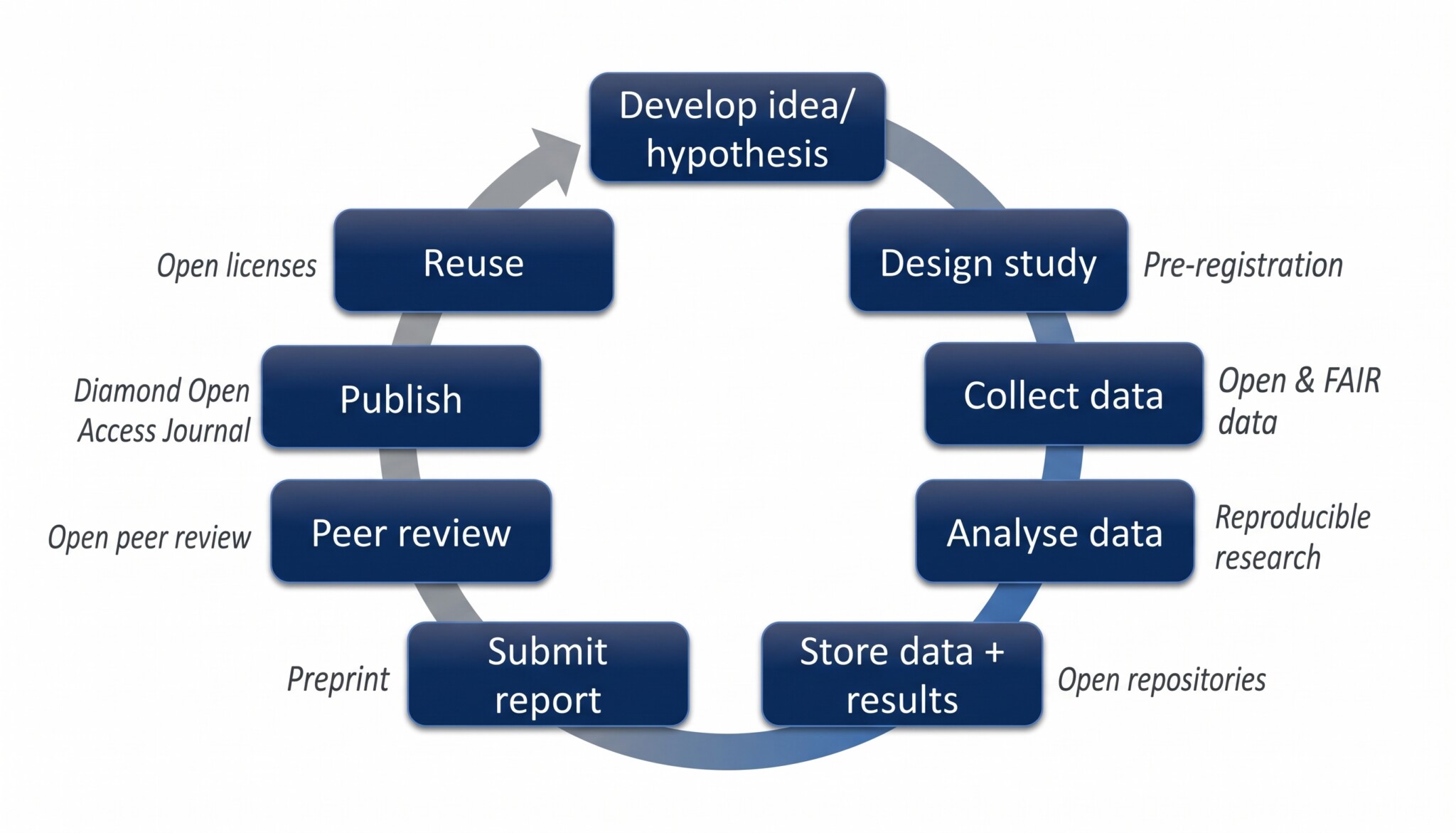
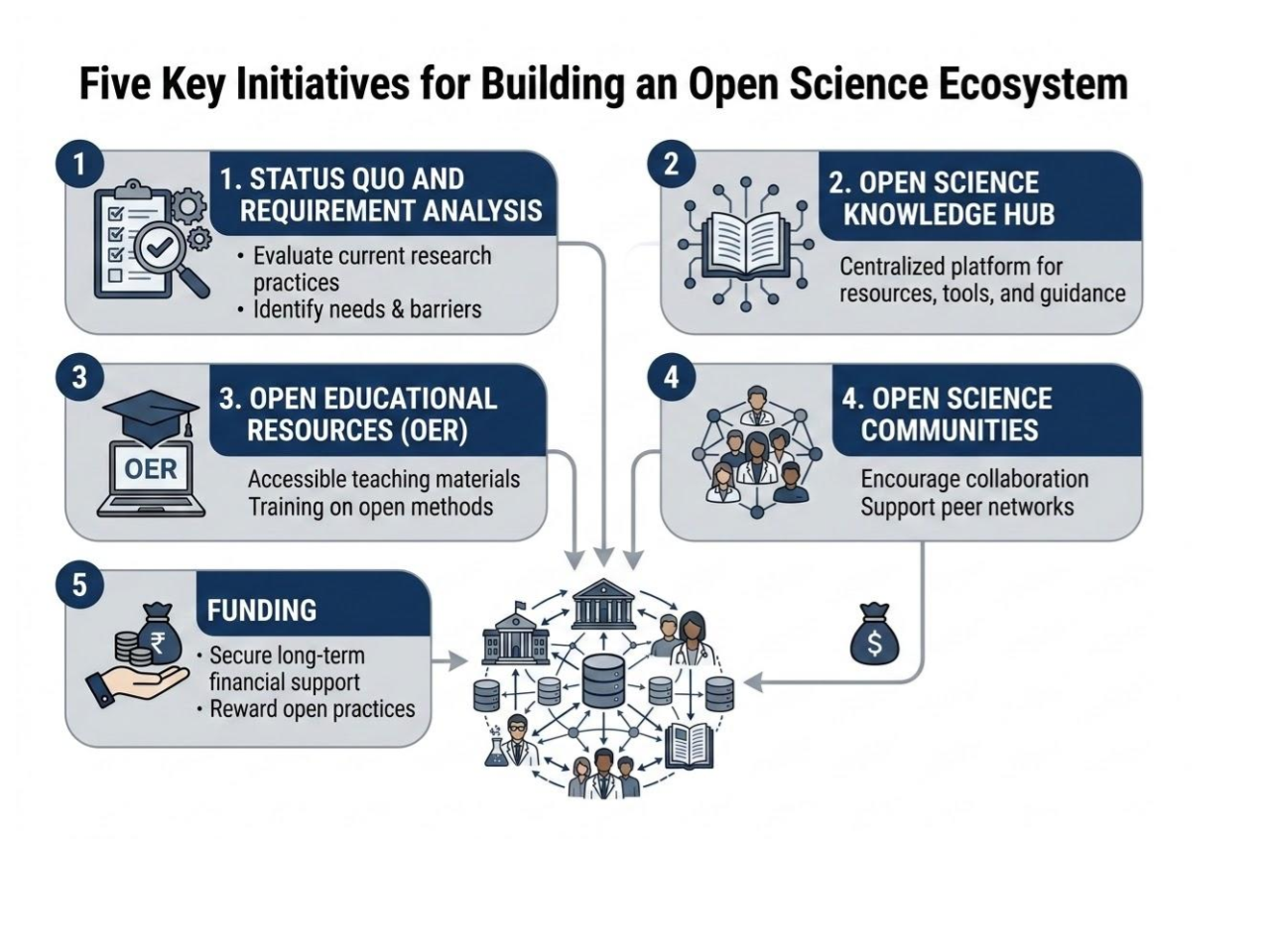
As you can see in Figure 1, Open Science principles can play a role in every step of the research cycle. That said, we should not leave researchers to adopt these principles on their own. Instead, we need to establish an environment that actively supports, acknowledges, and mandates Open Science activities (cf. [1]). In the following paragraphs, we introduce five initiatives for establishing an Open Science ecosystem within research-performing organizations. While it might seem weird at first glance, even private companies driven by commercial interests can benefit from an open environment. More on this later, let’s get started!
It’s not unlikely that existing Open Science activities are underway at your academic organization – whether led by the library or the IT department. Maybe some dedicated faculty members striving for greater openness in research and teaching launched an activity? Rather than establish yet another service, the final goal should be to connect existing efforts and identify service gaps. At times, it may be more important to focus on visibility and findability; hence, a useful first step is getting an overview of these activities, interlinking them, and connecting with the individuals in charge.
At this stage it is also important to check which policies and guidelines are provided on the university or faculty level. Open science can gain more momentum if the leadership of the research institution promotes an Open Science strategy and commits to Open Access, Open Data or the FAIR principles [2]. The successful implementation of Open Science principles requires both bottom-up and top-down initiatives.
The next logical step is to initiate a requirement analysis. This can be accomplished using online questionnaires for a broader reach, conducting semi-structured interviews with selected department representatives for in-depth feedback, and hosting focus group discussions to elaborate on ideas to address identified gaps in Open Science services. Possible questions are:
- Which Open Science practices would you like to learn more about?
- Which obstacles prevent you from doing Open Science?
- At which stage of the research process do you need support regarding Open Science?
Initiative 2: Open Science Knowledge Hub
A central entry point is essential for researchers, research support staff, and anyone else seeking guidance on Open Science. A web portal can navigate users to relevant resources and services. As people become increasingly used to interacting with artificial intelligence technologies, a chatbot could be a useful tool. However, direct access to specialists like an Open Science officer remains invaluable, particularly for those at the beginning of their Open Science journey who might not know what to search for. Such a website can collect requests, similar to software issue tracking. No need to search for the expert, the tickets will be assigned automatically! This hub can integrate services and consulting across Open Access, open and FAIR data management, repositories, and reproducibility.
Initiative 3: Open Educational Resources
The concept of Open Educational Resources (OER) is twofold: First, they complement the services identified in Initiatives 1 and 2 with learning materials, which are – surprise, surprise – openly accessible! Guidelines, recommendations, best practices, checklists, templates, and successful, real-world examples can be very helpful and address many needs. In addition, self-paced instructional videos allow learners to study at their own pace. Ideally, these materials are designed such that they can be reused or integrated into educational curricula, which brings us to the second aspect. Education is a core university function and publishing open educational materials can enhance its reputation, as seen in, for instance, the popular MIT OpenCourseWare. To achieve this, educators might need support with open licensing, metadata standards, and open-source tools software.
Initiative 4: Open Science Communities
The idea of so-called Open Science Communities originated in the Netherlands. The aim was to connect researchers and research support staff interested in Open Science through local networks. These communities foster collaboration and increase the visibility of existing expertise within research organizations by hosting webinars, hands-on workshops, and showcases of success stories. It’s a great way to share needs, concerns, doubts, address knowledge gaps, and discover solutions developed by other researchers. Today, many Open Science Communities thrive in different cities and countries alongside related initiatives, such as the Reproducibility Network.
Initiative 5: Funding
Whether we like it or not, Open Science is rarely considered during the execution of research projects. Consequently, researchers lack the time to release their data or software openly, as they write papers or finish their next grant proposals. Providing small funds can be very helpful to enable tangible Open Science activities, such as preparing data to align with the FAIR principles or creating software documentation to facilitate reuse. Furthermore, funding calls increasingly require dedicated Open Science sections in proposals to make sure that research outputs remain accessible and reusable after the project ends. Experts can assist researchers in drafting these sections and designing implementation strategies for Open Science principles.
All of the concepts summarized in these five initiatives center on the implementation of Open Science principles within research-performing organizations. However, private companies driven by commercial interests can also benefit from these principles. Many of them need to collect some sort of data, develop software, and write reports. Ideally, this should be done in a way that enables reusability. This is precisely where Open Science principles can help. Why shouldn’t we strive to make a company “more open internally”?
If you want to learn more or need support to foster these initiatives, don’t hesitate to contact us!
See you next week!
References
- Konkol, M., Chang, L., Da Silva Mano, A., Deon, F., Koelen, M. T., Korringa, D., Mettinkhof, R., Nelson, A., Ostermann, F. O., Rietbroek, R., Werff, H. van . der ., Venus, V., & Zurita Milla, R. (2021). ITC’s Strategic Plan for Open Science 2021-2025 – Towards an Open Future. Zenodo. https://doi.org/10.5281/zenodo.5113578
- Wilkinson, M., Dumontier, M., Aalbersberg, I. et al. The FAIR Guiding Principles for scientific data management and stewardship. Sci Data 3, 160018 (2016). https://doi.org/10.1038/sdata.2016.18
Leave a Reply