 Building Digital Bridges Across Municipalities, Research, and Technology
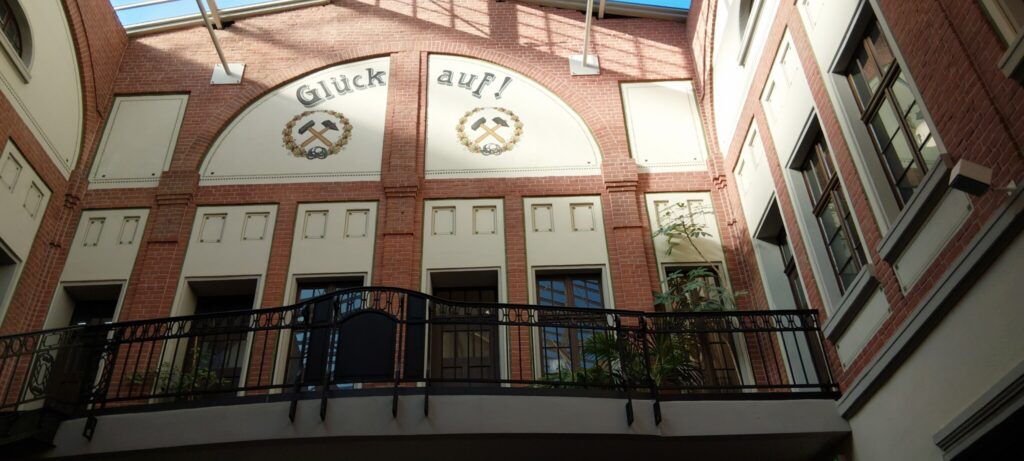
This year, the KomMonitor family came together for the 4th KomMonitor Community Day. Our host, G.I.B. NRW (Gestaltung, Innovation und Beratung in der Arbeits- und Sozialpolitik GmbH) recently opened the doors of the historic Lohnhalle in Bottrop for the event. G.I.B. NRW has intensively supported the KomMonitor family for many years, whether introducing the software in North Rhine-Westphalian social planning, offering regular consultation hours, or providing digital self-learning courses. Where miners once collected their paychecks, local leaders and developers recently gathered to shape the digital, data-driven future of smart cities. The historic venue provided a fitting backdrop for an impactful Community Day filled with cross-city networking, deep dives into new platform features, and hands-on afternoon workshops dedicated to upcoming updates and joint innovation.
Building Bridges: Cross-Sector Collaboration
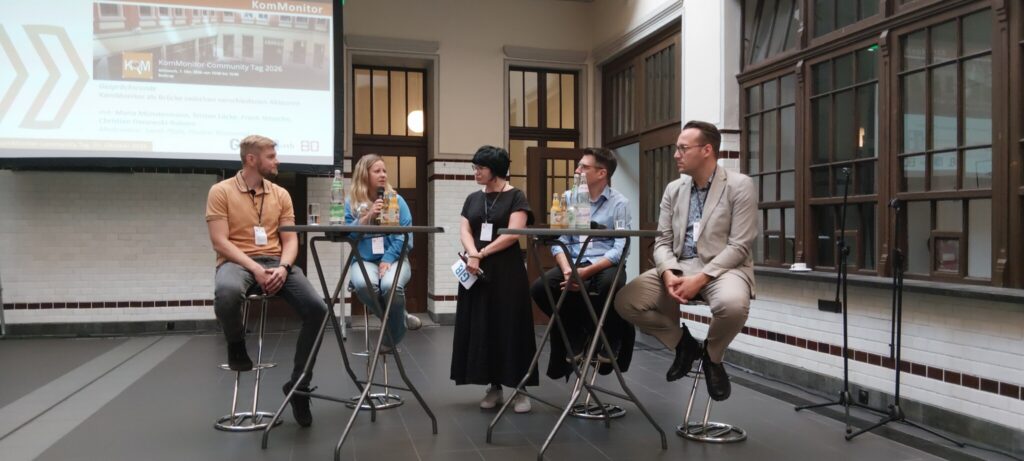
The first item on the program was a 45-minute panel discussion. Representatives from local governments, academia, and support agencies explored how KomMonitor serves as a bridge across stakeholders. Drawing on practical experiences from a municipality, the session highlighted how the platform fosters a cultural shift: moving from static reporting to collaborative, data-driven dialog. Small-scale data offers immense potential for labor market matching and childcare planning, provided privacy and contextual interpretation are maintained. The key takeaway was clear: successful digital transformation requires ongoing training, clear role definitions, and early integration of practical feedback into software development.
Best Practice: Multi-Tenancy in Kreis Recklinghausen
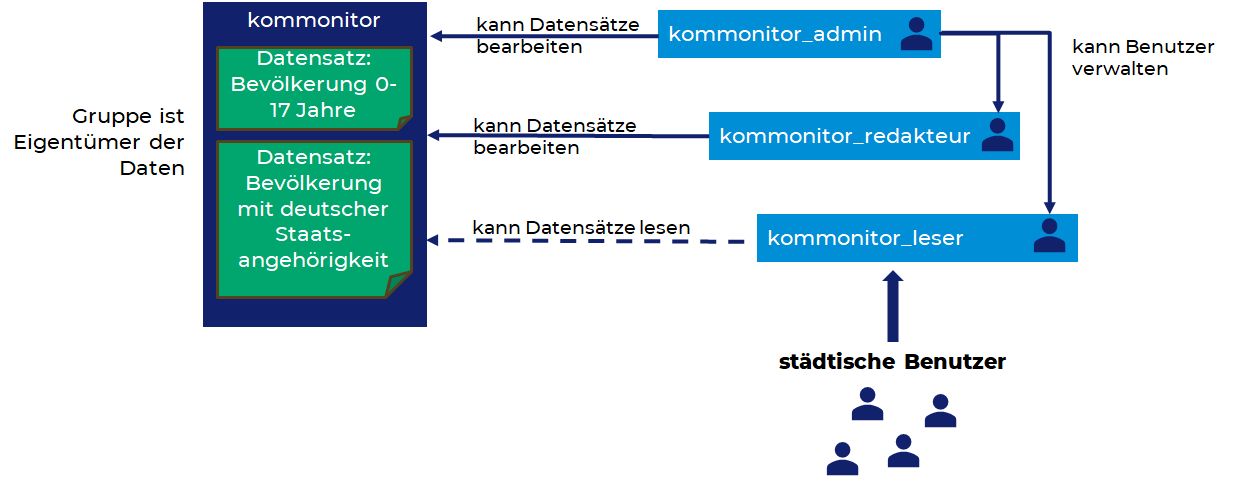
Following the panel discussion, the Kreis Recklinghausen, who has used KomMonitor in the smartdemography project for several years now, gave a workshop report. This report demonstrated the practical implementation of a multi-tenant setup for district-wide collaboration. To ensure data autonomy and seamless cooperation across municipalities, Kreis Recklinghausen established a standardized user and role permissions framework. By defining clear group hierarchies, flexible cooperation agreements, and separate tenant environments, municipalities can manage their own specific datasets while sharing common indicators. This structured approach prevents chaotic workflows, safeguards data privacy, and serves as a blueprint for scalable inter-municipal data management.
Development Insights
Keeping with a beloved tradition, the development team from Bochum University of Applied Sciences and 52°North GmbH gave a deep dive into the platform’s ongoing development. These are this year’s top new features and improvements:
- Implementation of a new automated indicator processing approach based on the OGC API – Processes standard
- Improvements to the reporting tool regarding the workflow performance
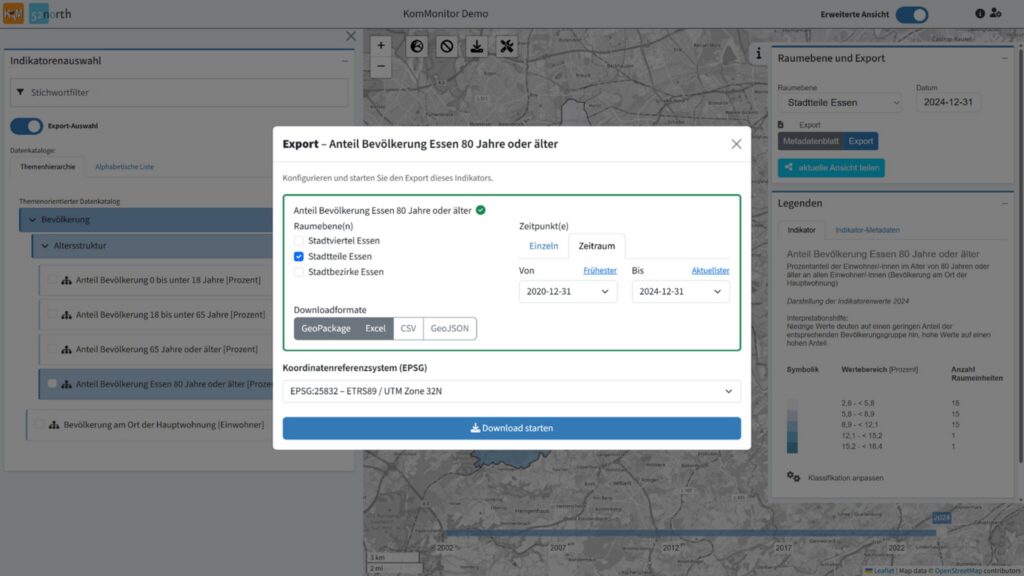
- The progressing KomMonitor Web Client migration, including user interface redesigns, the support for categorical data and a dedicated data export component
- Further development of the multi-tenancy approach by introducing the support for parallel spatial unit hierarchies
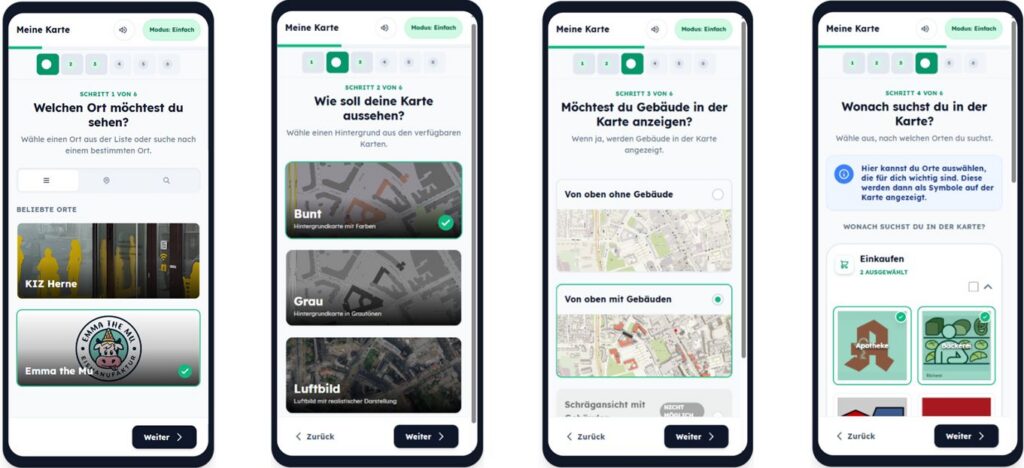
52°North also reported on the status quo regarding a KomMonitor Dashboard. In the last year, we developed a concept for a KomMonitor Dashboard as a future visualization option. We held several workshops with municipal representatives to establish target group requirements. Based on the insights gained, we defined practical use cases, created UI designs and clickable mockups, and designed a comprehensive technical concept. We are now looking forward to following up on the KomMonitor Dashboard vision within the community. In addition, the Bochum University provided insights on research and teaching regarding KomMonitor. They presented the DiKomAll project, in which interdisciplinary researchers and practitioners collaborate with co-researchers with learning disabilities to develop accessible digital participation formats. As part of the project, they evaluated KomMonitor to reduce barriers by simplifying user interactions and terms for groups with lower reading skills or map uncertainties, ensuring that results remain meaningful for decision-making processes.
It is worth noting that a significant portion of these updates was developed through important funding support provided by MAGS NRW.
Workshops
While the lunch break provided ample opportunity for a light refreshment and engaging conversations within the KomMonitor community, the second half of the KomMonitor Community Day offered an exciting change in comparison to previous years. Various workshops focusing on different topics invited participants to actively exchange experiences, ideas, and wishes.
Workshop 1: Interactive Exchange an User Interviews
This hands-on session provided a collaborative platform for participants to share their daily experiences with KomMonitor. Through structured interviews and open discussion, users gave direct feedback on practical workflows, reporting requirements, and regional data integration. The insights gathered highlight where administrative processes can be more streamlined and will directly inform future user support and feature prioritization within the KomMonitor community.
Workshop 2: Hands-On Exploration and Testing
Designed for both new and experienced users, this interactive session allowed participants to explore KomMonitor’s core analytical features firsthand. Working through realistic municipal scenarios, such as analyzing age distribution, configuring indicator radars, and mapping accessibility catchment areas, attendees tested advanced functions and data exports. The session fostered valuable peer-to-peer knowledge sharing and provided instant feedback on software usability.
Workshop 3: UI/UX Optimization and Pluralistic Walkthrough
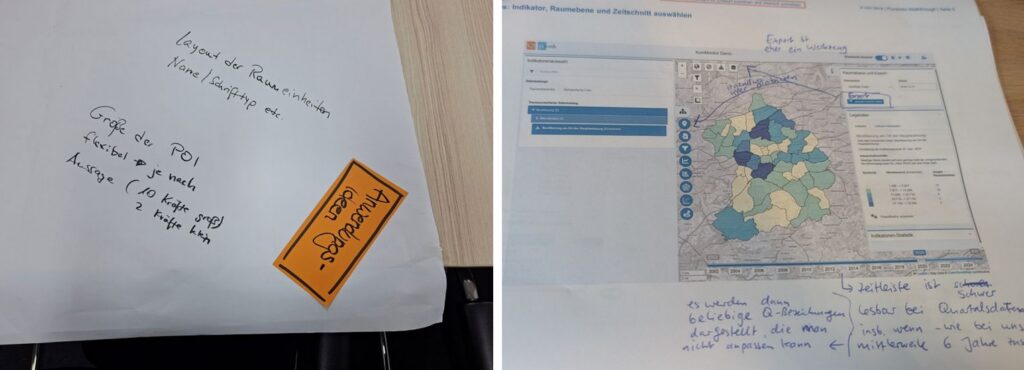
Led by 52°North and con terra’s UI/UX team, this specialized workshop focused on evaluating and refining KomMonitor’s user interface. Using a “Pluralistic Walkthrough” methodology, participants stepped into specific planning roles to execute end-to-end tasks, such as generating spatial filters, customizing map classifications, and exporting complex indicator datasets. The feedback collected during these walkthroughs will directly guide upcoming UI/UX improvements to make the platform even more intuitive.
The Road Ahead for KomMonitor
The 4th KomMonitor Community Day clearly demonstrated that digital transformation in local government relies on collaboration as much as technology. By bringing together municipal planners, developers, and regional partners, the event highlighted how shared data, practical feedback, and continuous exchange drive real-world progress. We look forward to seeing how these joint ideas take shape in the coming year!
Leave a Reply