
Assisting researchers to find spatio-temporal research materials
The National Research Data Infrastructure (NFDI = Nationale Forschungsdateninfrastruktur) is an interdisciplinary initiative that aims to increase the findability, accessibility, interoperability, and reusability of scientific resources. NFDI is composed of several discipline-specific consortia from humanities and social sciences (e.g., NFDI4Culture), engineering sciences (e.g., NFDI4Ing), life sciences (e.g., NFDI4Biodiversity), and natural sciences (e.g., NFDI4Chem). Another consortium focuses on the Earth System Sciences (ESS) and is called NFDI4Earth.
“NFDI4Earth will provide simple, efficient, open, and – whenever possible – unrestricted access to all relevant Earth system data, scientific data management and data analysis services. Major implementation guidelines are the FAIR principles which do impact the whole research data life cycle.” (https://www.nfdi4earth.de/about-us)
Three years ago, NFDI4Earth published a call for developing the so-called OneStop4All – a front-end web application that assists researchers in finding ESS research materials, accessing datasets and software, and learning about topics related to research data management. Needless to say that 52°North was very keen to contribute to this vision and was ultimately selected to implement it! Since then, we support the distributed NFDI4Earth developer team with consulting, architecture and software development. This is also a good opportunity to send regards to Pikobytes who helped us with designing excellent mockups we could use as a discussion basis for specifying the final product.
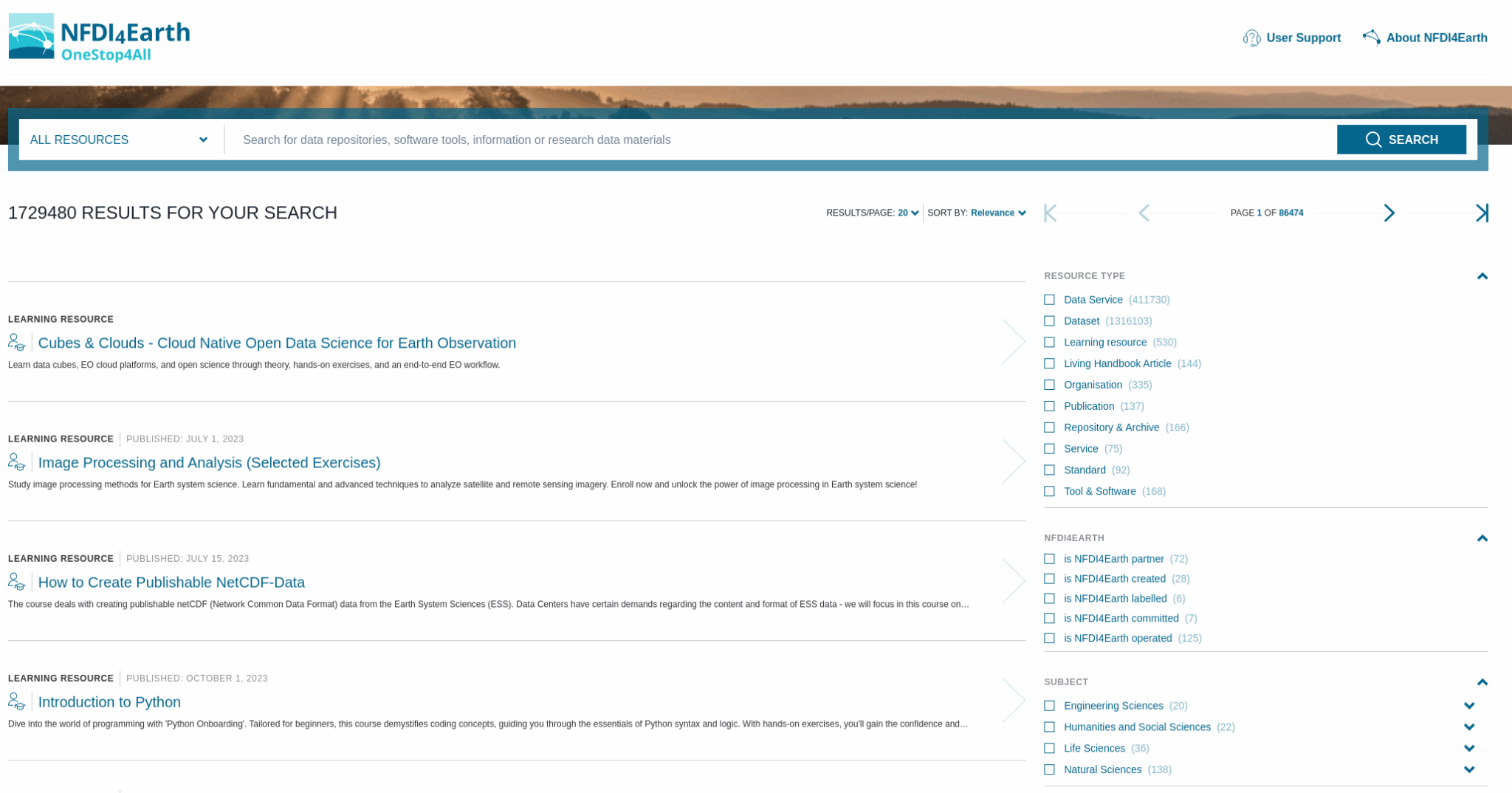
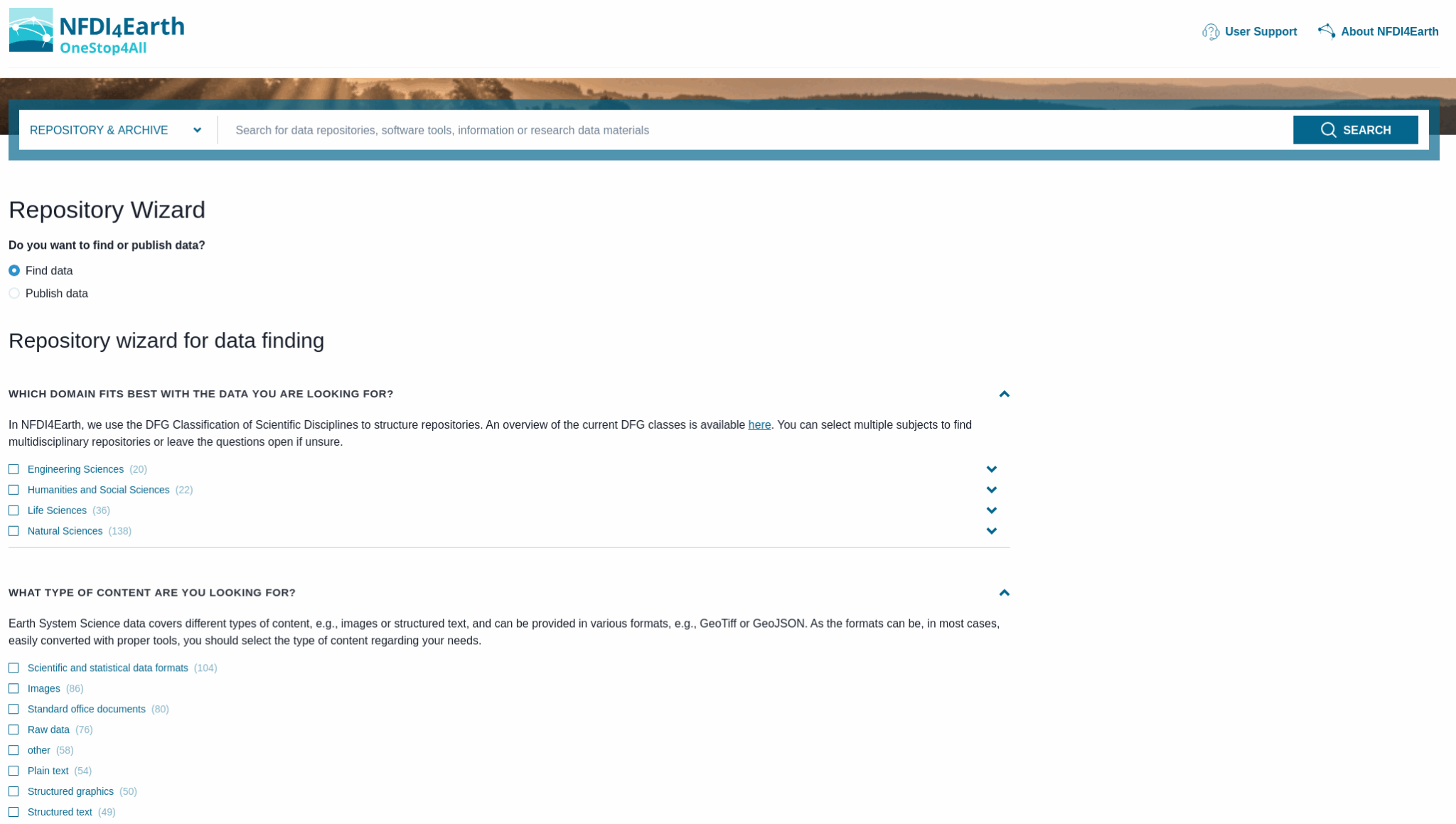
The NFDI4Earth team recently released a first version of the OneStop4All that offers several useful features. For instance, the search user interface (Fig. 1) provides access to thousands of ESS resources, such as datasets and services, but also information on repositories and research organizations. All this is based on the Knowledge Hub as the backend service. It also offers a number of filter options to narrow down the search results, for example, by data type, license, or spatio-temporal properties. Since the beginning, addressing users with and without knowledge of data management has been an essential quality criterion. While experienced users can directly benefit from the fine-grained filter options, new users can scrutinize the learning resources on research data management or receive guidance when looking for the right data repository through the Repository Wizard (Fig. 2). As is typical for projects developed by 52°North and within the NFDI4Earth initiative, the OneStop4All software is available as an open-source project.
This blogpost is not just a summary of the final project results, but rather an intermediate update. We’re happy to share that we have been awarded the opportunity to continue developing OneStop4All as a joint effort with our partner TU Dresden (TUD)! There are still some interesting challenges ahead as we work to expand the functionality of OneStop4All. For example, despite using the filter options, users may still be confronted with a large number of search results. For this reason, we’re implementing an AI-based search feature. The idea is to develop a vector-based search mechanism that complements the current approach, which is based on keyword matching. Being able to find and access data is great, but certainly not the end of the research cycle. Users might also need tools to analyse the data found. To support this activity, we will integrate the workflow platform Galaxy with the OneStop4All. More information on how this could look can be found in my blog posts here and here. Another task will be to implement a metadata management interface for services. Users should be able to register new services or update the metadata of existing ones within the OneStop4All.
As you can see, we have quite some interesting tasks on the table and look forward to continuing the cooperation with the NFDI4Earth developer team. Whenever we have some interesting updates, we will keep you posted!
Leave a Reply