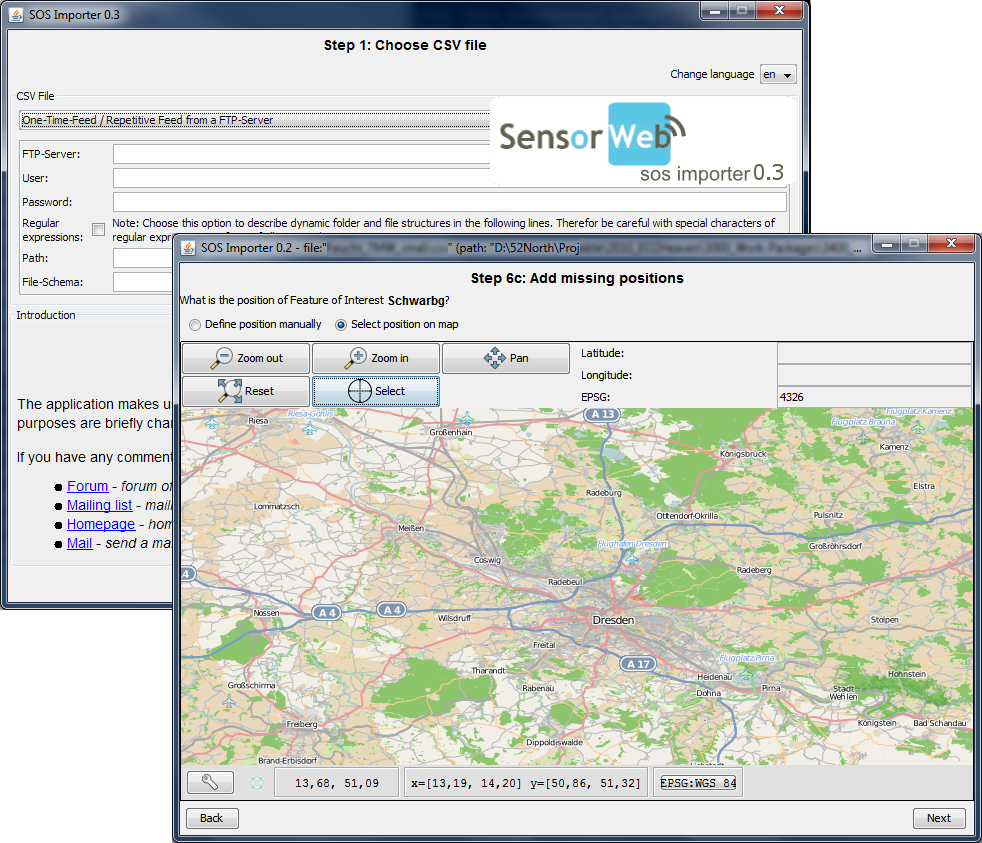
Last Friday, a new version of the SOS (Sensor Observation Service) Importer was released. This is a tool for importing observations from CSV (Character Separated Values) files into a SOS instance using an eight step wizard for guiding a user through the often cumbersome process of data transformation.
GIS IQ – Esri Germany’s new blog
Esri’s Education Team – Daniel Schober, Grischa Gundelsweiler und Jan Wilkening – write about what you need to know about GIS in school and at the university from an Esri perspective. How do you create a web map? Which international research projects are important – the GIS IQ bloggers provide practical tips, point out important sources for literature and data and report on events in the community.
Get additional information and be informed of new blog posts via the GIS iQ twitter account!
Streaming based WPS
I intend to implement a streaming based WPS on the top of the 52°North WPS framework for enabling WPS basic processes to handle input and output spatial data streams. This post shows the current state of the work, as well as further steps.
The Open Geospatial Consortium (OGC) Web Processing Service (WPS) specification lacks a way to deal with continuous spatial data streams. Think about sensors providing potentially unbounded spatial data streams that must be processed before being meaningful to end-users. Real-time geoprocessing (McCullough et al., 2011) or Live Geoinformation (Foerster et al., 2012) have been described recently, but we still miss an open implementation that can be seamlessly integrated with existing OGC standards, namely WPS. My work at 52°North deals with solving this issue.
Multimedia streaming
The idea comes from multimedia streaming. It allows users to consume media without the need to download the entire content (Timmerer and Müller, 2010). Thus, the user accesses and consumes chunks of media. In the spatial context, we can think of these chunks as feature collections (for vectors) or tiles (for rasters). Early consumption of spatial data chunks makes sense since it enables rapid assessment of process results at an early stage, which could allow, for instance, one to cancel the process if results are not as expected.
Multimedia streaming has two main modalities: on demand streaming and live streaming. The former provides output streaming for content stored in the server (e.g., Dailymotion, Vimeo), whereas the latter does not intend to store media but to transfer it as soon as it is available (e.g., Ustream, Skype). Both modalities can be implemented for spatial data with some caveats. On demand streaming is implemented as “Output Streaming” and live streaming as “Full (input/output) Streaming.”
Below is a comparison of the streaming modalities, adapted from (Foerster et al., 2012): Current WPS (at the top), Output Streaming (in the middle), and Full Streaming (at the bottom). Where tasks are parallel, initial response time gets reduced.

Output Streaming
Output Streaming WPS receives input data as a whole, splits it into chunks, and starts processing each chunk for publishing intermediate results. This reduces latency, i.e., time to access process results. A prototype of output streaming for both vector and raster data has been already implemented, see the videos.
Output Streaming WPS on vector data
Output Streaming WPS on raster data
Intermediate results are published by means of a plain text file called ‘playlist’, in which URLs pointing to new available results are appended by the server. The client constantly checks the playlist looking for new content in order to download, decode (if needed), and display it. At the end, the client assembles all chunks in a single layer.
It is important to note that not all algorithms could benefit from Output Streaming. Particularly, algorithms that require focal or global knowledge are not supported. Nevertheless, alternative ways of splitting spatial data for parallel processing could enable support for more algorithms. This is an open research field in Geographic Information Science.
Full Streaming
On the other hand, Full Streaming WPS is yet to be implemented. It will receive spatial data streams and meanwhile, start processing them for publishing results. Full Streaming WPS will enable one to process unbounded data streams because it receives, processes, and publishes spatial data simultaneously. This is a potential new field of action for WPS.
Conclusion
In summary, streaming based WPS brings new capabilities for WPS: first, it allows one to access intermediate process results and, second, it enables processing of unbounded data streams (Borsutzky, 2011). There is a prototype of the former, whereas the latter is still to be implemented. At the end of the project the source code will be available at the 52°North Geoprocessing Community’s repository. Stay tuned!
References
- H. Borsutzky. (2011). Streaming von Geodaten mit webbasierten Prozessierungsdiensten. (Unpublished diploma thesis). University of Münster, Germany.
- T. Foerster, B. Baranski, and H. Borsutzky. (2012). Live Geoinformation with Standardized Geoprocessing Services. In J. Gensel, D. Josselin, and D. Vandenbroucke (Eds.), Bridging the Geographic Information Sciences (pp. 99–118). Berlin, Heidelberg: Springer Berlin Heidelberg. 2012. Retrieved from http://www.springerlink.com/index/10.1007/978-3-642-29063-3_6
- A. McCullough, S. Barr, and P. James. (2011). A Typology of Real-Time Parallel Geoprocessing for the Sensor Web Era. In T. Foerster, A. Bröring, B. Baranski, B. Pross, C. Stasch, T. Everding, and S. Maes. (Eds.) (2011). Integrating Sensor Web and Web-based Geoprocessing. CEUR Workshop proceedings (Vol. 712). Utrecht, Netherlands: CEUR. Retrieved from http://ceur-ws.org/Vol-712/
- C. Timmerer and C. Müller. (2010). HTTP Streaming of MPEG Media. Proceedings of the Streaming Day 2010, Udine, Italy, September 16-17, 2010.
xmlcodegen: Why you should generate Geotools bindings for your XML map data
So as you may or may not have been following my blog posts or status reports recently, I’m currently a Google Summer of Code 2012 student for 52°North. My project primarily deals with the problem of providing bindings for OpenStreetMap data such that they may be used within the Web Processing Service (WPS). Yet here I am talking about xmlcodegen, a component that is primarily part of Geotools… why?
It turns out that the WPS relies a lot on Geotools to for handling various map data types. This makes sense, as Geotools itself is intended to provide an easy way to interact with various geospatial data formats. By making use of Geotools, WPS can tap into its features and capabilities, and thus support interactions and manipulate all these data formats without necessarily having to reinvent the wheel for each file format. The same goes for any other projects or packages that make use of Geotools.
As such, when the task came to implement bindings in WPS for OpenStreetMap data, I naturally looked into the capabilities of Geotools to see if such functionality was already provided. It turned out that it was not, however mechanisms existed to easily implement such functionality; this was exacerbated by the fact that OpenStreetMap data was primarily in XML format.
This blog post is mostly dedicated to my experiences in generating bindings for Geotools from XML-based file formats. It is meant to supplement Geotools’ articles in terms of some of the problems I encountered, and the solutions I found for them. I also will give a brief overview as to the progress of the project thus far.
Disclaimer: I don’t in any way claim to know all there is to Geotools’ xmlcodegen process, nor in any way act as the authoritative answer for solutions to the issues I address.
What is XML? Why is knowing this important in the context of OpenStreetMap?
XML is a markup language. In the context of OpenStreetMap data, it is primarily used as means to transport and convey map data in a meaningful format to both humans and machines. As such, it tends to be considerably more verbose than other file formats (consider a 303GB uncompressed OSM XML planet file, compared to its 21GB OSM PBF relative), however this verbosity is mitigated by the fact that several mature libraries and tools already exist to handle this file format. Consider for example, all of the ways in Java to interact with XML:
- « Previous Page
- 1
- …
- 64
- 65
- 66
- 67
- 68
- …
- 84
- Next Page »